

Christopher Nolan’s adaptation of The Odyssey has already made a huge amount of money, attracted tremendous controversy, and encouraged many people to buy one of the translations of the poem (I’ve been rereading it using Daniel Mendelsohn’s very recent translation). I enjoyed the film but have also enjoyed the controversy. I’m bringing together my original response, my reviews of a couple of other movie adaptations, and a little more on the history. I hope this will purge me of my obsession and get me back onto what I should be thinking about, namely Spinoza, Hegel, and Marx.
My review of the Nolan Odyssey
Well, as part of the celebration of my 76th birthday, I went to see Christopher Nolan's film The Odyssey yesterday [ie 24 July]. I feel proprietorial about Homer's poem because my father's family comes from the real Ithaki. I wasn't expecting to enjoy the film, but I did. (NB there might be spoilers below for anyone who doesn't know the story.)
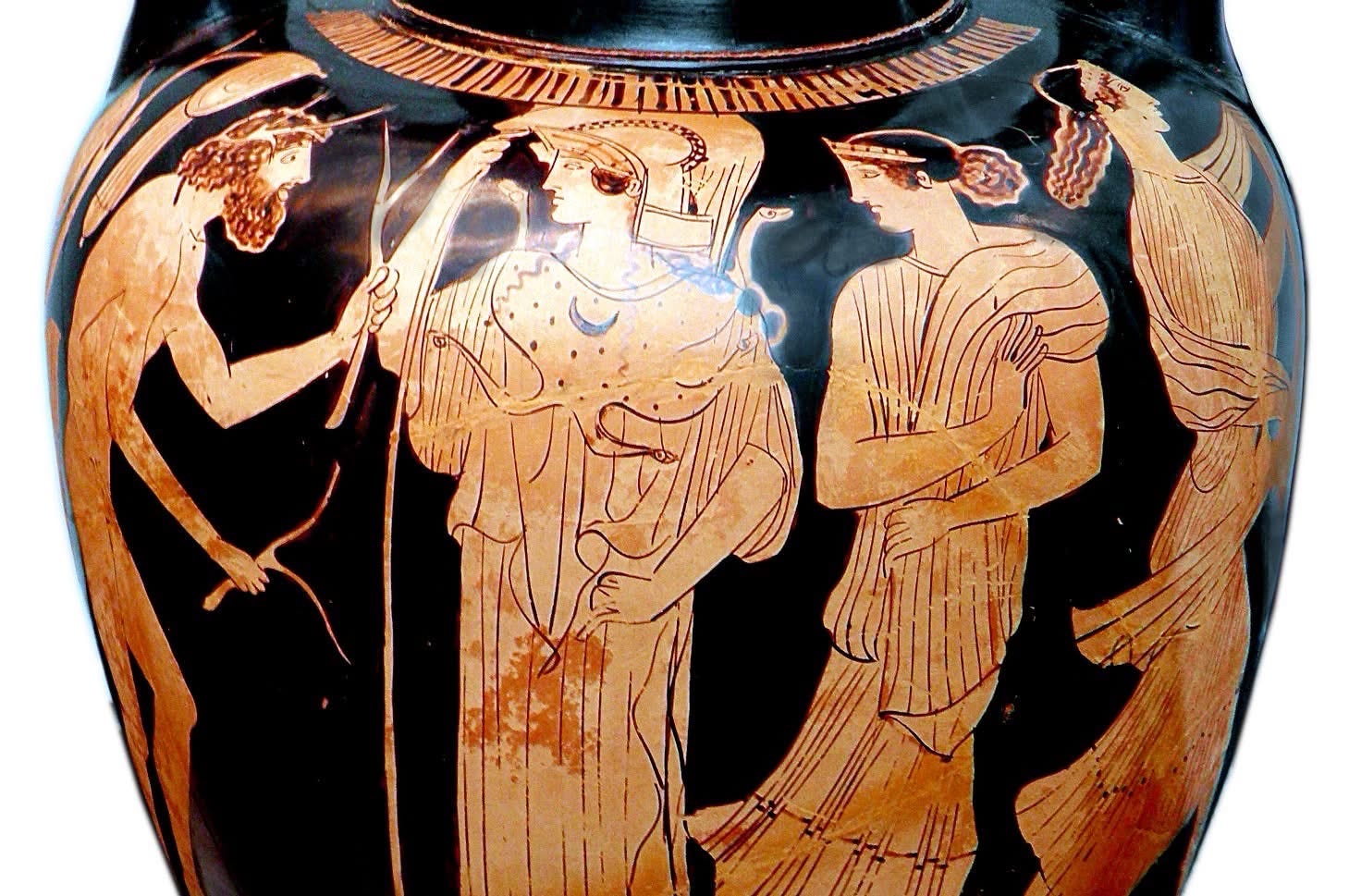
There are definite weaknesses. As several classicists have pointed out, there's not enough sex and humour in the film. I was annoyed by two particular omissions - the excision of Odysseus telling the cyclops Polyphemus (who is really scary in the film) that his name is Nobody and the disappearance of the beautiful scene where the Phaeacian princess Nausicaa discovers a naked shipwrecked Odysseus when she and her maids are doing their washing on the beach (to compensate there's a classical portrayal of the scene below). There's also a certain amount of pseudo-historical nonsense about the Sea People's depredations and the end of civilization.
But as a piece of story-telling, the film works and is quite faithful to the original. Nolan weaves a non-linear narrative similar in structure to Homer's although differing in detail. The basic casting - Matt Damon as Odysseus, Anne Hathaway as Penelope, Samantha Morton as Circe, Charlize Theron as Calypso, for example, - is quite convincing. An enormous amount of nonsense has been written about Lupita Nyong'o as Helen of Troy. Reactionaries like Elon Musk wouldn't know that at the start of the Odyssey the gods in Olympus are able to discuss Odysseus’s plight because his sworn enemy Poseidon is away partying with the 'Aethiops' (which probably means 'burnt-faces'). Nyong'o has a kind of electric beauty that is much more arresting than having yet another Northern blonde. I'm not sure it was such a good idea to cast her also as Helen's sister Clytemnestra - how can you have two most beautiful women in the world? - but this is a very brief part.
There's less of the gods' intervention, feminist critiques from Penelope and Circe, and a lot of psychologizing - Odysseus dallies with Calypso because he's guilty about the sack of Troy, rather than because of divine anger. But this is all quite coherent and one sign that a story is alive is when people adapt it. The basic narrative works powerfully, the suitors are - er - suitably awful, and the moment when Odysseus reveals himself by stringing his bow and wasting them is as satisfactory as it should be.
Of course, Jake, it's Chinatown - or rather Hollywood. I don't think Nolan is a great director. But this one delivers.
Two (or three) other movie adaptations
Ulysses (1954), directed by Mario Camerini. Not a bad adaptation - (as you’d expect) Kirk Douglas is a much more dynamic Odysseus than Damon, Silvana Mangano does a pretty good double act as Persephone/Circe, and, with its beautiful Italian actresses, it’s much sexier than the Nolan film - Nausicaa (Rossana Podesta) gets her rightful share of the story. But the film fails the Nobody test and suffers from the crudities of 1950s epics. Its making inspired the Alberto Moravia novel that Godard adapted as Le Mepris (1963). Maybe the latter film qualifies as an Odyssey adaptation, even though (with Fritz Lang sardonically playing himself) it dramatizes the impossibility of such an adaptation. Made by Godard at the height of his powers, Le Mepris is certainly a much better film than either Ulysses or the Nolan Odyssey.
The Return (2024), directed by Uberto Pasolini (no relation, but Luchino Visconti was a great-uncle). As the title implies, this is about the culmination of The Odyssey, Odysseus’s return to Ithaca. Small-scale compared to Nolan’s mega-production, completely linear story, no gods, no humour, though sex is inescapable when Juliette Binoche is playing Penelope. But there are parallels between the two films - as you would expect in a film co-written by Edward Bond, war is omnipresent and Odysseus is paralysed by the memories of what he did. Ralph Fiennes is convincing in the part, and there’s a touch of the demonic when he starts killing (one can never really forget he played Amon Goeth). Both he and Binoche are very good. The slaughter of the suitors is unambigously horrible (still much toned down compared to the original), and Marwan Kenzari plays Antinous as a complex character, much more interesting than Robert Pattinson’s preening villain in the Nolan version. The Return was partly made on Corfu, one of the same group of Seven Islands as Ithaca, so it feels much more like Greece than the Nolan film. Penelope forgives Odysseus a bit quickly for staying away for ten years, but this is about the only light note in a grim though powerful film.
The weight of history
The Odyssey is an epic poem. Neither it nor Nolan’s adaption are therefore subject to demands of historical veracity, one of the sillier themes in the debate about the film. Nevertheless Nolan invites such criticism by himself inventing a historical context for the story - the end of the Bronze Age (a particularly absurd line in the film) etc. There’ve been some objections to my dismissal of this as ‘pseudo-historical nonsense’ that the Sea Peoples were real. So I was relieved to see that the Odyssey translator Emily Wilson is equally dismissive in her devastating review of the film (https://www.lrb.co.uk/the-paper/v48/n14/emily-wilson/an-uncomplicated-man).
Nevertheless, I’m struck that the great classical historian M I Finley, generally very critical of attempts to read history into the Greek myths, writes: ‘We know that the end of the thirteenth century [BC] saw widespread devastation throughout the Peloponnese and in central Greece, the breakup of the Hittite empire, destruction in Cyprus and in northern Syria. Documents from Cyprus and from Ungarit in northern Syria, tantalizing and fragmentary though they are, leave little room for doubt that some form of massive marauding activity lay behind these almost simultaneous devastations, and more and more experts are coming to link that activity with two Egyptian texts, long known, from which the appellation “Sea Peoples” is derived. and the temptation grows to place the destruction of Troy VIIa [the level of what archaeologists believe was ancient Troy that was destroyed by fire] in the same context,’ (The World of Odysseus [Harmondsworth: Pelican, 1979], p. 173)
So civilization - in the shape of the Mycenaean palace economies that had developed in Greece in earlier centuries - did collapse. Nevertheless, The Odyssey emerges much later, in Archaic Greece, say the 8th C BC, and portrays events that are supposed to have taken place four centuries earlier. According to Oswyn Murray, ‘later Greeks were unaware of almost all the important aspects of the world that they portrayed in heroic poetry, such as its social organization, its material culture and its system of writing. Even the [post-Mycenaean] Dark Age itself dropped out of sight: in book I of his history, Thucydides saw a gradual but continuous advance from the world of the Homeric heroes to his own day,’ (Early Greece [London: William Collins, 1993], loc. 156-65) In Homer there is no sense of any discontinuity between the two eras. Indeed, as in Shakespeare, there’s anachronism, with features of the post-collapse society of competing nobles (basilees) back-projected onto the more centralised and bureaucratic tributary societies of Mycenaean Greece.
The sense of doom, of a dying civilization, that pervades the Nolan film is quite absent from the poem; Nolan is clearly using The Odyssey to express fears provoked by the contemporary crisis of liberal imperialism. In Homer lots of bad things happen and the human lot is sad (as Achilles’s ghost tells Odysseus - another excision), but there’s a serenity that is quite absent from the film. I suppose I prefer the poem to the film, but still enjoyed the Nolan version more than Wilson did as a successful retelling.
Thx!
I have read the translations by Fagles and Wilson. I favour Wilson but Bernard Knox’s introductions both to Fagles’ Iliad and to his Odyssey have kept them on my bookshelves. Does Mendelsohn’s translation offer anything significantly new, as in requiring me to spend £30 on yet another translation, or should I buy The New Age of Catastrophe instead?