
Well, as part of the celebration of my 76th birthday, I went to see Christopher Nolan's film The Odyssey yesterday. I feel proprietorial about Homer's poem because my father's family comes from the real Ithaki. I wasn't expecting to enjoy the film, but I did. (NB there might be spoilers below for anyone who doesn't know the story.)
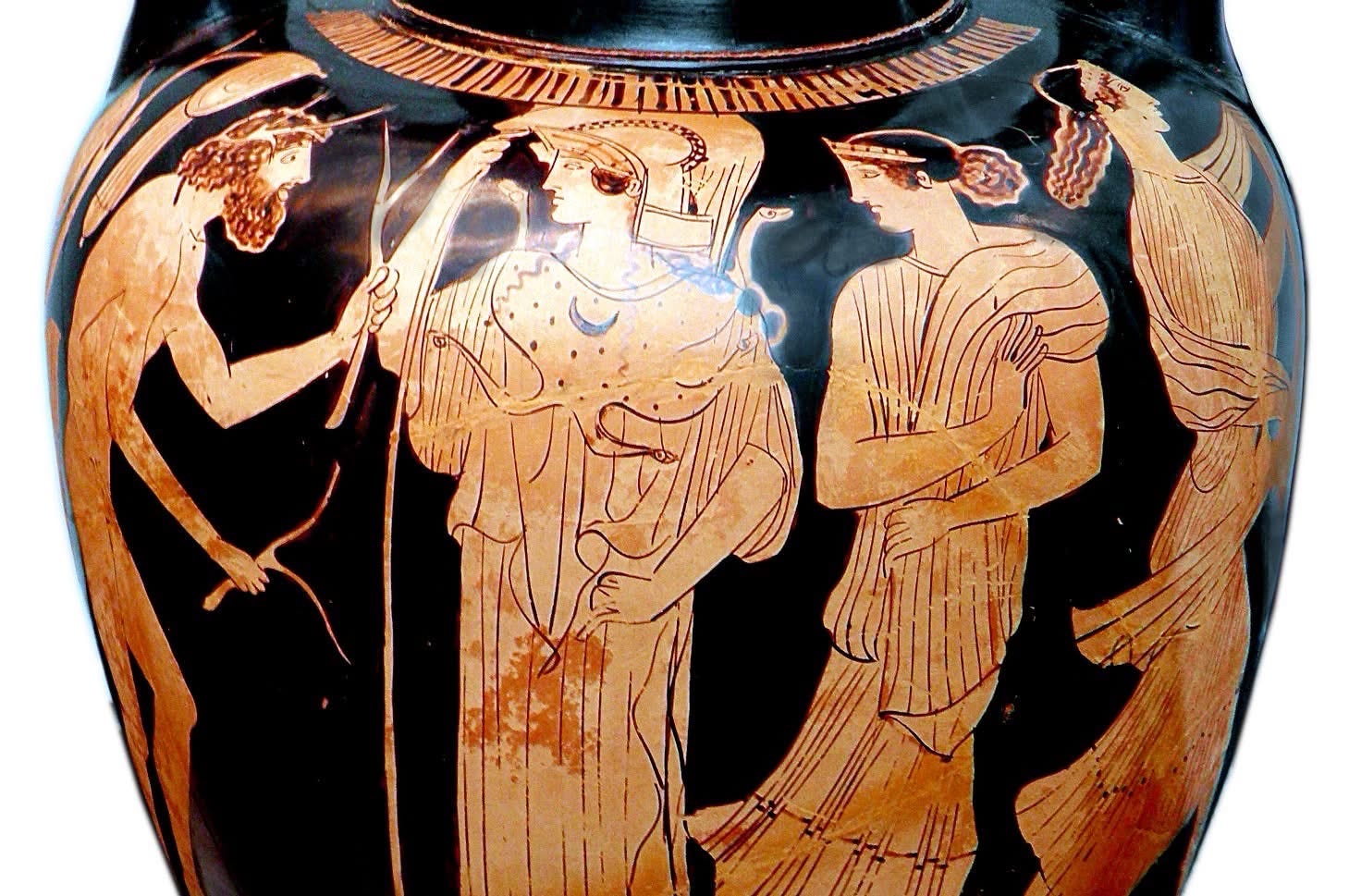
There are definite weaknesses. As several classicists have pointed out, there's not enough sex and humour in the film. I was annoyed by two particular omissions - the excision of Odysseus telling the cyclops Polyphemus (who is really scary in the film) that his name is Nobody and the disappearance of the beautiful scene where the Phaeacian princess Nausicaa discovers a naked shipwrecked Odysseus when she and her maids are doing their washing on the beach (to compensate there's a classical portrayal of the scene below). There's also a certain amount of pseudo-historical nonsense about the Sea People's depredations and the end of civilization. *
But as a piece of story-telling, the film works and is quite faithful to the original. Nolan weaves a non-linear narrative similar in structure to Homer's although differing in detail. The basic casting - Matt Damon as Odysseus, Anne Hathaway as Penelope, Samantha Morton as Circe, Charlize Theron as Calypso, for example, - is quite convincing. An enormous amount of nonsense has been written about Lupita Nyong'o as Helen of Troy. Reactionaries like Elon Musk wouldn't know that at the start of the Odyssey the gods in Olympus are able to discuss Odysseus’s plight because his sworn enemy Poseidon is away partying with the 'Aethiops' (which probably means 'burnt-faces'). Nyong'o has a kind of electric beauty that is much more arresting than having yet another Northern blonde. I'm not sure it was such a good idea to cast her also as Helen's sister Clytemnestra - how can you have two most beautiful women in the world? - but this is a very brief part.
There's less of the gods' intervention, feminist critiques from Penelope and Circe, and a lot of psychologizing - Odysseus dallies with Calypso because he's guilty about the sack of Troy, rather than because of divine anger. But this is all quite coherent and one sign that a story is alive is when people adapt it. The basic narrative works powerfully, the suitors are - er - suitably awful, and the moment when Odysseus reveals himself by stringing his bow and wasting them is as satisfactory as it should be.
Of course, Jake, it's Chinatown - or rather Hollywood. I don't think Nolan is a great director. But this one delivers.
* There’ve been some objections that the Sea Peoples were real. Maybe so but I’m impressed by the fact that The Odyssey emerges in Archaic Greece, say the 8th C BC, and portrays events that are supposed to have taken place four centuries earlier. But there is no sense of discontinuity between the two eras. Indeed, as in Shakespeare, there’s anachronism, with features of what I remember Oswyn Murray portraying as a society of petty kings back-projected onto the more centralised and bureaucratic tributary societies of Mycenaean Greece. The sense of doom, of a dying civilization, that pervades the Nolan film is quite absent from the poem. In Homer lots of bad things happen and the human lot is sad (as Achilles’s ghost tells Odysseus - another excision), but there’s a serenity that is quite absent from the film. I suppose I prefer the poem to the film, but still enjoyed the Nolan version as a successful retelling.